
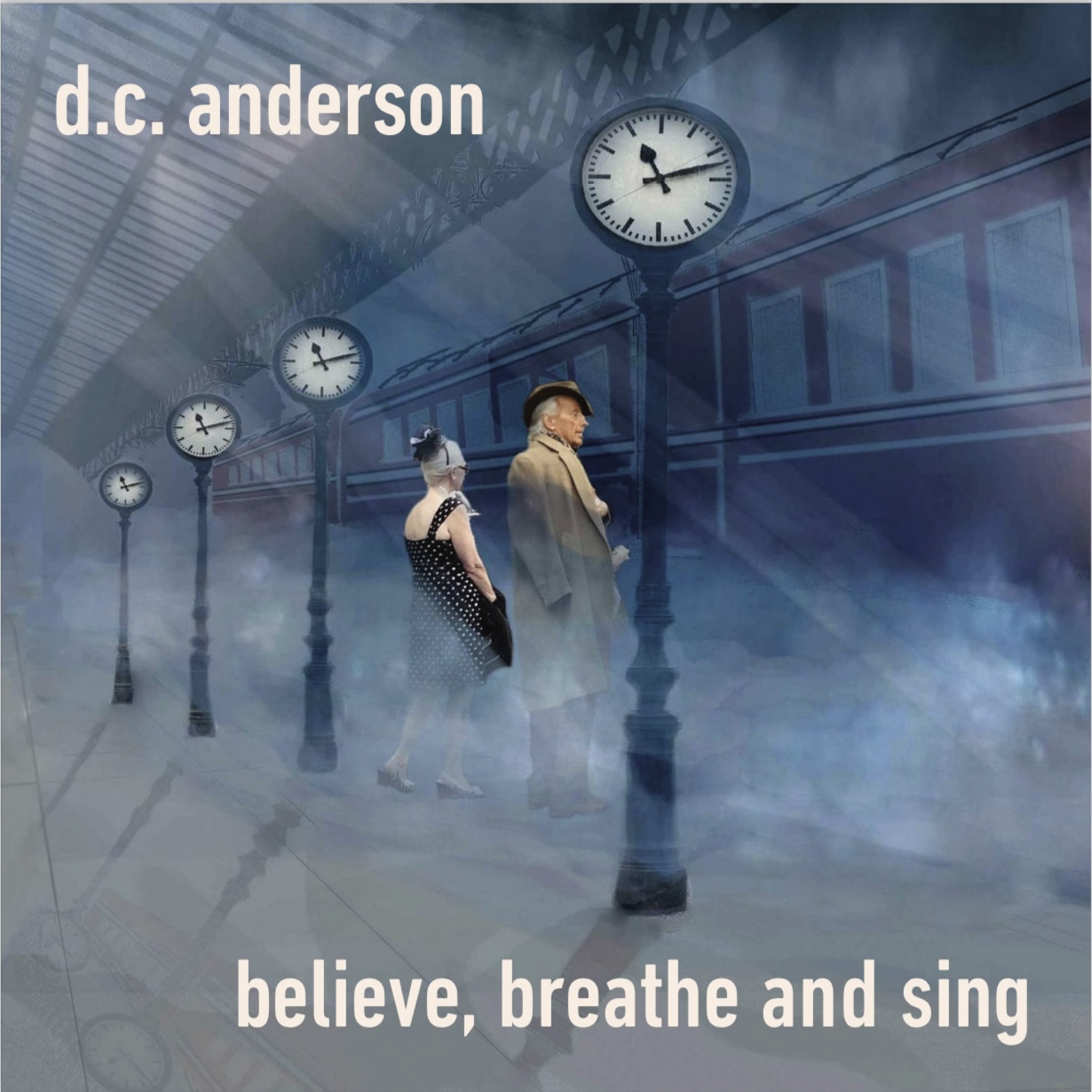
cover art by Alan M. Richards; image courtesy of D.C. Anderson
Album Review of D.C. Anderson: Believe, Breathe and Sing
I’ve reviewed D.C. Anderson a few times already here at the blog. In 2023, I reviewed his intimate-sounding album House Concert. About a year ago, I discussed Sharing the Night with Darkness, his collection that included a lot of heavy and/or personal life-issue oriented songs, often touching upon difficult subject matter. And just a couple months ago, I covered D.C.’s protest song, “No Kings Live Here,” one of a small series of protest singles he issued this spring. Now it’s time to take a look at D.C.’s October 2024 release, Believe, Breathe and Sing.
The songs on D.C.’s most recent full-length release, Believe, Breathe and Sing, cover a lot of ground, from melancholic and insightful to dark and heavy. Indeed, a whole lot of thoughtful and heavy. And, in a couple of instances, it’s joyful and silly. As I always note, D.C.’s presentation style on almost all of his songs is very stage-like, though not necessarily big-stage theatrical. Sometimes it’s small and intimate, as in a cozy theater where every breath can be heard. The amount of deep songs on this record make it a rewarding listen, but if you’re not at full emotional strength when you begin, it can be a bit overwhelming as D.C.’s voice is so effectively able to delve deeply into every strong emotion of every song, so many of which are weighty and introspective. Beyond that, it’s hard to sum up a 19-song record like this into an abbreviated yet thoughtful review, so I hope you don’t mind that I’ve decided share my thoughts as I go through it song by song.
The album opener – title song “Believe, Breathe and Sing,” is a perfect example of an intimate, soft-spoken (but clearly enunciated and dramatically phrased) song. In this case, the singing turns nearly spoken-word for emphasis. Quite effectively, I might add.
The Alan Schmuckler-penned “Sparrow,” next, is a melancholy number that D.C.’s voice emphasizes with well-placed cracks in the vocals, while the music is smooth. It’s one of the more memorable tracks on the record, exceptionally well-suited for D.C.’s delivery of this sort of soft, heartfelt song.
“Whiskey Blues” is a song from Jahn Sood’s folk opera The Disappearing Man, one of four tracks on this record from that musical. D.C.’s delivery of “Whiskey Blues” puts a solid, unique stamp on the original, taking a rougher-edged tack that, in this case, is very Simon Scardanelli-esque in many ways. Simon has long been a blog favorite, but I can’t recall ever before hearing another artist’s song that captures a similar tone, let alone also with a well-worn, bemused yet sincere delivery. For me, this is a standout track, though in part for that very specific reason.
“A Kiss” follows with some pleasant pianowork supporting D.C.’s subtly soft vocals. “Twenty Twenty Five,” next, is a nice – and, unfortunately, quite prescient – follow-up, as it supports similarly soft-touch vox with an acoustic guitar’s strum. Like the “Twenty Twenty Four” single I reviewed last year at the end of my the Sharing the Night with Darkness album review, “Twenty Twenty Five” is a D.C. Anderson co-write with Luke Wygodny.
Next, in the midst of such serious and/or heavy material, it’s nice when D.C. drops in a silly, playful number like “Fish Fry and Guava Pie,” with songwriter Ritt Henn’s consistent ukelele strum adding to the fun.
D.C. returns to weighty music with the softly-voiced, emotionally-wrought “Ethan and Emily,” then a song, “Love Song to a Friend,” that’s just as heavy but full of humanity and warmth, if still sadly so. And “The Worst Thing We Ever Did” follows with depth that revolves around religious contemplation, kind of tugging upon a thread that was buried in the previous number.
“Oh, My Diana” is a full-voiced, warmly-delivered rendition of the song penned by Matt Vinson and Matte O’Brien for a musical adaptation of Anne of Green Gables. There’s some important, supportive string work on this song. Digging through the credits, I assume this is the contribution of cellist Audrey Q. Snyder.
“Other Mother” is perhaps one of my favorites of the deeper songs on this record. It has a warm, pleasant humanity… and a more clear happy progression and ending than many of the other weighty songs on this album.
“Don’t Put My Baby Down” is slow and soft. It allows D.C.’s voice to soar briefly – but not too loudly – from time to time, as even its pleasantness feels a little ominous.
D.C. returns to The Disappearing Man the next track, this one “Old No. 22,” finally raising his voice to rich power for the first time in several songs. Then he pivots an energetic performance of Bryce Kulak‘s absurd – and absurdly fun – “Pelican,” with vocals, pianowork, and lyrics that are thoroughly entertaining, before returning to two more songs from The Disappearing Man. The first of those, “Sara,” is a rich, broadly-voiced number supported by a pleasant finger-picked guitar, which saddens toward the end. Then “Arms” is much more delicate, ending with “I will follow you as far as life is long,” a lyric D.C. sets down gently at the song ends.
“Funeral Blues” is, lyrically, the poem by W.H. Auden, with music written by Bryce Kulak. That’s some serious stylistic range for Bryce, too, when compared with “Pelican”! Kulak’s musical arrangement takes a much richer, darker tone on “Funeral Blues,” as does D.C.’s voice. David Robison‘s pianowork is a powerful backdrop, with the vocals employing the necessary power to equal the keys on the performance of this number.
“When the Angels Come to Call” features guitar, I believe, that’s picked almost as one would a harp, befitting this number that’s lighter, though no less serious, than much of the rest of the collection.
D.C. ends the record with an even lighter, quite pleasantly instrumented song, “For My Luck, I Suppose.” A song about the good people in D.C.’s life. As the lyricist, I suppose it’s his life, anyway: “Have I told you I love you? If I haven’t, it’s so. The best part of my luck is the people I know. My friends and my neighbors, the truest of hearts. Gentle, thoughtful and kind, equal parts.” And it’s the reason the memory of this album doesn’t seem so dark, when looking back, after completing each listen. In fact, I was a little surprised by its seriousness when I actually sat down to write the review in part because the closing number leaves the listener with a pleasant final thought, a warmth and reminiscence of all the good people in one’s life.
Of course, I love the light songs “Fish Fry and Guava Pie” and “Pelican.” These almost felt like Shakespearean comic relief, silliness to lighten the mood during a drama that’s otherwise full of tragedy. In this case, a lightness to serve as a pause from the album’s seriousness. My other personal favorites on this record include “Sparrow,” “Whiskey Blues,” “Other Mother,” and “Funeral Blues,” all very serious songs – that describes most of this record, after all.
A D.C. Anderson album is always a worthwhile listen. It’s often a journey, both within each song and throughout the record. And you always leave with a few new favorite songs. If you’re even remotely interested in folk music, theater music, or simply exceptionally well-performed songs with thoughtful lyrics, you’ll be glad you gave this album a listen.
More Recently
While I was writing and proofreading this review, D.C.’s new album, Song Stay Sung, was released – just a couple days ago, in fact, on June 6, 2025. I look forward to hearing D.C.’s new release.
 Geoff Wilbur's Music Blog