
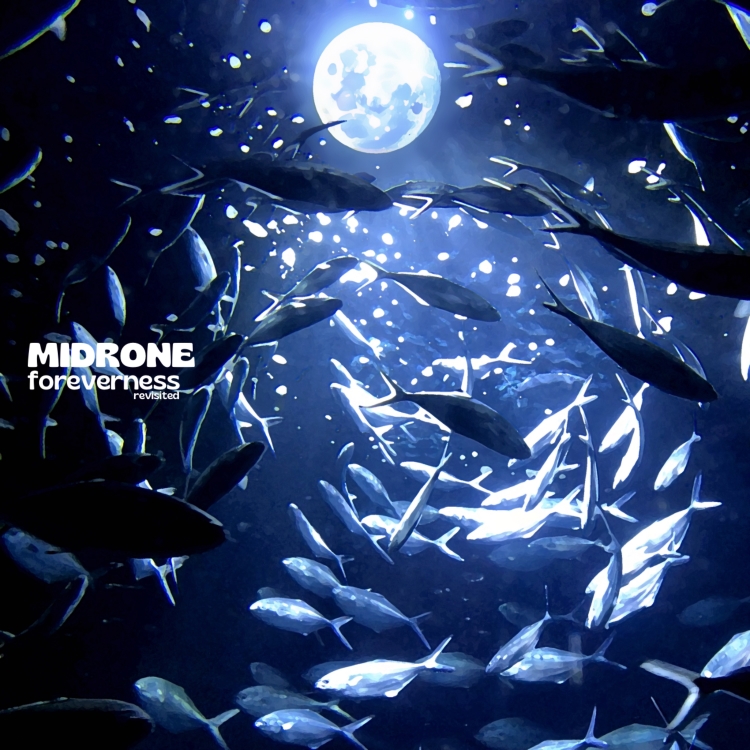
image courtesy of Midrone
Album Review of Midrone: Foreverness Revisited
There’s a style of classic rock that drips with progressive rock styling. That’s what Midrone delivers on Foreverness Revisited. The vocals soar. The music is heavy but uplifting. And the musical progressions are, well, progressive yet not obscurely so. Rather, they’re pop-friendly. I even hear some Beatles-esque passages and structures on a track or two. As a result, this record is accessible to fans of more straightforward classic rock, with the requisite harmonies and hooks to appeal to a broader audience, primarily structured within a progressive rock framework. Just that combo alone marks this as a pretty cool release, notwithstanding how enjoyable the songs are, too.
Foreverness began as a collection of demos in 2012 and 2013. Foreverness Revisited is Midrone’s Paul J. No’s attempt to complete that decade-old vision with proper production value, so No almost entirely re-recorded Foreverness as Foreverness Revisited, featuring himself on vocals, keyboards, guitars, and programming, joined by JP Benadjer (guitars) and Seb Bournier (drums), with the record mixed and mastered by David Paredes.
“A Miracle is in the Air” kicks things off with pingy, progressive synthwork. Fuller instrumentation develops quickly, as the song soars musically behind a vocal line that lifts and drops alongside the music. To my ear, the final result comes across with the steadiness of a Peter Gabriel crossover track that’s set to the music of a reined-in version of Asia.
It’s followed by the song that made me think of the Beatles, “The Little Walk Down Memory Lane,” a catchy little ditty that’s one of the record’s more pop-accessible numbers. It’s also my personal favorite on this disc, though I enjoy spinning the record from beginning to end; it’s without a weak link, suggesting a disc full of potential favorites, depending on your nuanced musical preferences.
Midrone skews synth-meets-guitar prog on “Many Ways to Say Goodbye,” then comes in a bit more mellow on “Don’t Mean Anything,” a kind of Moody Blues-ish number. The constant is a tuneful vocal that leans pop, even though it’s paired with progressive musicianship.
Most of the rest of the disc is comprised of various combinations of elements I’ve already noted. I particularly like “The Story of Jimmy Jack,” which combines softly soaring segments with more aggressive passages.
Another song that deserves mention is the most experimental, progressive song on the record, mixing spoken word narration and engaging music to tell the story of the lead-up to the Wall Street crash of 1929 and, of course, given the song’s title, the aftermath – “The Party is Over.” (It may cause you to google John Jacob Raskob. I studied finance, among other things, and I can’t believe I didn’t already know the quote this song leverages!) I generally dislike spoken word in songs, but it really works here, one of the coolest song concepts you’re likely to ever discover. If you ignore the rest of this review, you should check out this song. It’s not a barometer of whether or not you’ll like the rest of the record, but it’s something you really should hear at least once. Or several times – it seems to get even better with multiple listens.
Finally, “Foreverness” closes the collection. It’s a good stylistic summation of the rest of the record. Most good progressive rock records end with this sort of satisfying conclusion, and Midrone delivers.
In its entirety, Foreverness Revisited resides in that musical corner of progressive rock that delivered mainstream hits for prog-influenced rock acts in the ’70s and ’80s, adeptly straddling those two worlds. Whether your tastes lean mainstream or progressive, I’d suggest giving this record a listen.
 Geoff Wilbur's Music Blog