

Album Review: Bob Lord – The Six Observables

Bob Lord – The Six Observables

image courtesy of Bob Lord

Album Review of Bob Lord: The Six Observables

Experimental progressive rock music is some of the hardest to decide to write about. It’s rarely apparent from a first listen how the listening experience will evolve over multiple trips through the album, whether the music will reveal nuances upon repeated listens, whether it will embed itself into the brain as a familiar friend over time, or if the music will devolve into gimmicky quirkiness after several runthroughs. In the case of Bob Lord‘s The Six Observables, I had more than just his accolades to go by; past personal experience was also on my side. I’ve previously reviewed two of Bob’s band Dreadnaught’s albums and one of his solo releases, so I expected to grow increasingly fond of The Six Observables over the course of repeated spins. I suppose you can never be certain, but in this case, my presumption was correct.

The album itself is primarily a collection of mostly-brief soundscapes. Or, perhaps, spacescapes. The album consists of short tracks of less intense music using a location and date naming convention, suggesting encounters at various times and places, with each short track being followed by a longer instrumental performance. Stylistically, the music suggests space encounters, and Bob’s comments accompanying the album’s release, noted in this blog post on his website, reveal the album content to be UFO-related.

Among the short cuts, you get some Schroeder-esque light piano on “USS Nimitz Tic-Tac Encounter – 2004.” “Miracle of the Sun at Fatima – 1917” sounds a bit like a music box. “Black Traingle From the Atlantic – 2019” is really just a long buzz with beeps. “Betty & Barney Hill Through Franconia Notch – 1961” sounds like the occasional jangle of piano keys you’d expect to hear from a jazz pianist between songs. And the album-closing short track, “The Incident At Exeter – 1965” – the longest of the short entries at 1:21 – sets the musical ship down nicely, quietly, subtly landing the ship, setting us all down for our next adventure.

As I noted, in between the short cuts are longer songs. Among the more substantial numbers, you find aggressive guitar noodling and distorted thumping, tied together with an incessant rhythm on “Instantaneous Acceleration,” a title that’s exceptionally fitting; at 1:19 it’s actually shorter than the longest short number, but both stylistically and in the scheme of the album, it clearly qualifies as a longer cut. “Low Observability,” meanwhile, is more than three minutes of a humming buzz with spacey, atmospheric beats and twoinks bubbling up throughout. (Yes, I said “twoinks.”) “Hypersonic Velocities,” probably my favorite track on the album, particularly if you’re searching for a track to be enjoyed as a standalone song, has a peppy tempo, a thumping rhythm, a playful recurring hook, and a mostly-empty-space bridge that provides a mini-reset, helping extend the listener’s interest, allowing the faster tempo to resume, carrying the song’s energy to its abrupt end. And “Biological Effects” features the sort of spacey sounds you hear throughout the disc but through a lens of psychedelic rock distortion, replete with whining guitar and thick, chunky drums. The longer numbers cover a lot of ground, all within the album’s cohesive, experimentally spacey sonic lane.

The songs are carefully ordered on this disc, as there are some cool connections between the short and long tracks. Most notably, I can’t imagine “Transmedium Travel” without the “Black Triangle From the Atlantic – 2019” lead-in, but all of the transitions are well-considered.

When all is said and one, how The Six Observables makes for an enjoyable listen is something I can’t entirely explain. It’s the curse of trying to review experimental rock music. If it’s done well, an active listener will discover an enigma wrapped in a riddle. But I can tell you that the album is very well assembled, with the space/UFO encounter theme tying everything together, while the music is sonically expressive of such a theme. And yes, The Six Observables will grow into an old friend, albeit a weird old friend, after several listens.

Previous Geoff Wilbur’s Music Blog Coverage

You can find my review of Bob Lord’s April 2021 release, Playland Arcade, via this link. You can also find my reviews of two albums from Bob’s band Dreadnaught – Hard Chargin’ and Northern Burner – at the Blog.
 

Album Review: Bob Lord – Playland Arcade

Bob Lord – Playland Arcade

image courtesy of Bob Lord

EP Review of Bob Lord: Playland Arcade

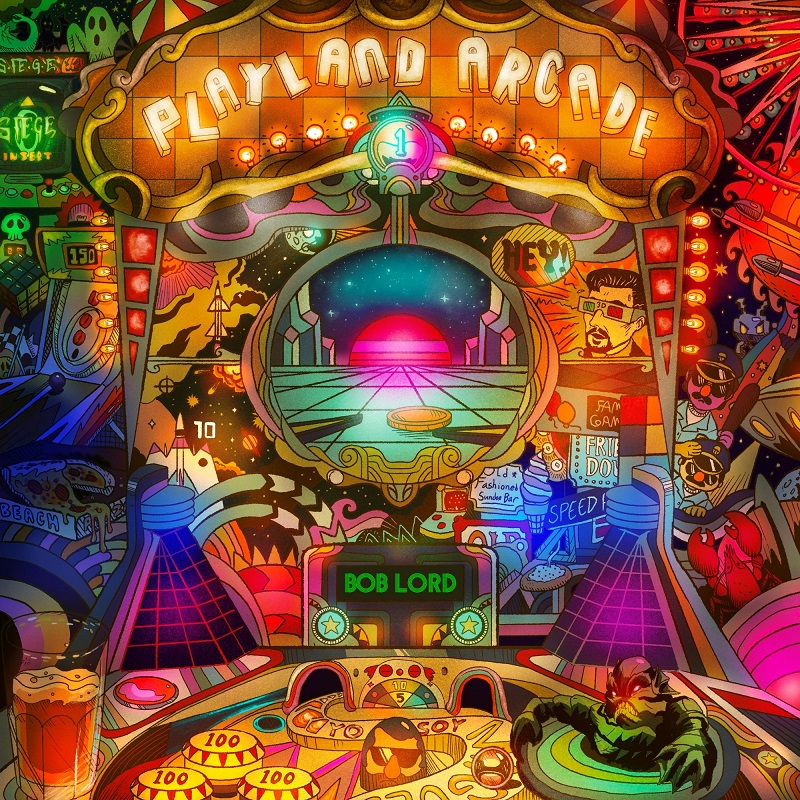
Progressive? Experimental? Quirky? I’m never quite sure how to describe Bob Lord‘s music. Bob is kind of like a musical Picasso. He creates masterpieces you don’t quite understand, but you know you’re witnessing something worth paying attention to, worth remembering, worth enjoying. Slated for an April 27, 2021 release, Playland Arcade contains nothing that disputes any of that. If you’re familiar with Bob’s work within Dreadnaught, whose 2017 album Hard Chargin’ I reviewed here at the Blog, this solo album is much more esoteric.

The music on Playland Arcade tends to fall into one of three categories: video game, movie soundtrack, or cartoon soundtrack. Actually, most of it falls into zero categories, but I can imagine it being used creatively and effectively in one of the three aforementioned situations. And since the album is named for the Playland Arcade at Hampton Beach, NH, this mix of sounds isn’t surprising; the album is an arcade-caliber auditory assault on the senses.

Now, I’ve listened to movie soundtracks. The Raiders of the Lost Ark soundtrack is a classic. And cartoon soundtracks can be incredibly detailed. In my early music journalist days, I reviewed The Carl Stalling Project: Music From Warner Bros. Cartoons 1936-1958. Carl Stalling’s music was pure genius, and I had that album in heavy rotation on my CD changer for quite a while. I can’t say I’ve listened much to video game music albums, but I’ve seen them cross my desk; no, Buckner & Garcia’s Pac-Man Fever doesn’t count because it was music about video games rather than music from video games, though I practically wore out that cassette from repeated plays when I was a teenager.

Still, as oddball as Playland Arcade is, and as unusual as it is to hear music from these categories, Bob Lord’s vision and execution are masterful, and though I don’t sit alone just listening to it, it’s an interesting backdrop for me while doing other things, though the music occasionally seizes my attention, so I can’t be doing anything too attention-intensive while listening.

I’ll start from the beginning and end at the end, but I’ll skip around in between like a kid in a beach town on a rainy day with nothing else to do, dropped at an arcade to wait out the storm and unsure how to spend his pocketful of tokens.

“Fry Doe” opens the collection as an instrumental musical number that establishes a tone and rhythm, adds bits and pieces to itself as it progresses, building in power and taking the listener on a journey, either through a video game or, toward the end especially, maybe also through a jungle, while delivering memorable musical runs and recurring hooks.

The most attention-grabbing song on the disc may be “Yo Soy Miguel,” perhaps because the lyrics – or, rather, the title phrase – is delivered with such an enthusiastic jolt, though the keyboardwork, as well, adds its memorable, energetic splash. Later in the disc, “Get Yer Drink Up” is a subtler, more rhythmic vibe in the same vein, with a beat that almost sounds as if it was being taped while walking down the street, with the percussionist tapping it out on the wall, garbage cans, his own body, even clapping when necessary; I dig it.

True to its name, “In For the Kill” is an excellent example of tension-building background music, as if taken directly from a crime drama. “Night Sweats” continues in the eerie vein but also launches into a mid-song musical bridge that could be taken from a 1970s progressive AOR album. Also on “Night Sweats,” I’m especially partial to the ratcheting sound effect used in it, a bit like an old wind-up alarm clock… or toy… or maybe even just a ratcheting wrench. “The Backyard Swan” also plays in this ’70s TV/movie soundtrack musical space, simultaneously channeling both The Mod Squad and a Clint Eastwood movie soundtrack.

“Beach Pizza” is soundtrack background music of a walk that ends with a panoramic view, and it flows right into “Tenderly,” with its slack-key guitar style twang, as if straight from a Hawaiian beach… perhaps with a pizza? (Does the Playland Arcade serve Hawaiian style pizza?)

One song specifically reminds me of the Raiders of the Lost Ark soundtrack. I could easily envision a scene where “Fanfare for a Losing Team” was the background music. Perhaps a scene in Marrakesh where Indy and his companions are being chased, with surprises around every corner. The song has sounds of tension building intertwined with success. I can see how it could be a team’s fight song, as well, but I’m gonna go with Indiana Jones on this one. Much shorter “Last Word” contains the same sort of seemingly-Raiders-inspired tension, too, and it’s clearly movie soundtrack fodder with its big, climactic ending.

A personal favorite of mine, “Wyoming Vice,” has the western feel its name suggests, while 35 second long “Lobster Roll” feels like it may come from either a ’70s sitcom with an overly enthusiastic music bed or, perhaps, a blooper reel.

“Mighty Forces” builds into a celebratory song, with barn dance-worthy fiddling and a more-frantic-seeming-than-it-actually-is pace really getting your heart racing over the course of the tune.

I’ll close by mentioning another favorite, “Siege,” which ends the album with energetic rhythm. Very ’80s electro-pop/rock styled music, blending pop song techniques with video game-worthy sound effects and progressive/experimental stylings in at least one of the bridges for an effective fast-moving song, both before and after the mid-song, odd musical interlude, which, by the way, is something I’d expect from a ’70s progressive rock album. Bob accomplishes the feeling of a 12-minute prog rock opus in the much shorter (only 5:16!) “Siege.”

Beginning to end, Playland Arcade is a well-conceived, peculiar collection of unusually catchy odd songs and sound effects. It’s kind of like an audition tape for various types of background music and soundtrack work. Bob Lord is joined by some of exceptionally talented musicians on this well-conceived project (as noted on Bob’s website here), and you’re not likely to find much else like it. Interesting from the first listen, it continues to grow on you with each subsequent spin.

Looking Ahead

Well, Dreadnaught’s website says there’s a new Dreadnaught album, Northern Burner, scheduled for a summer 2021 release. First things first, though; Playland Arcade will be released in three days, on Tuesday, April 27th, and you can pre-order it here.