Album Review: D.C. Anderson – Believe, Breathe and Sing

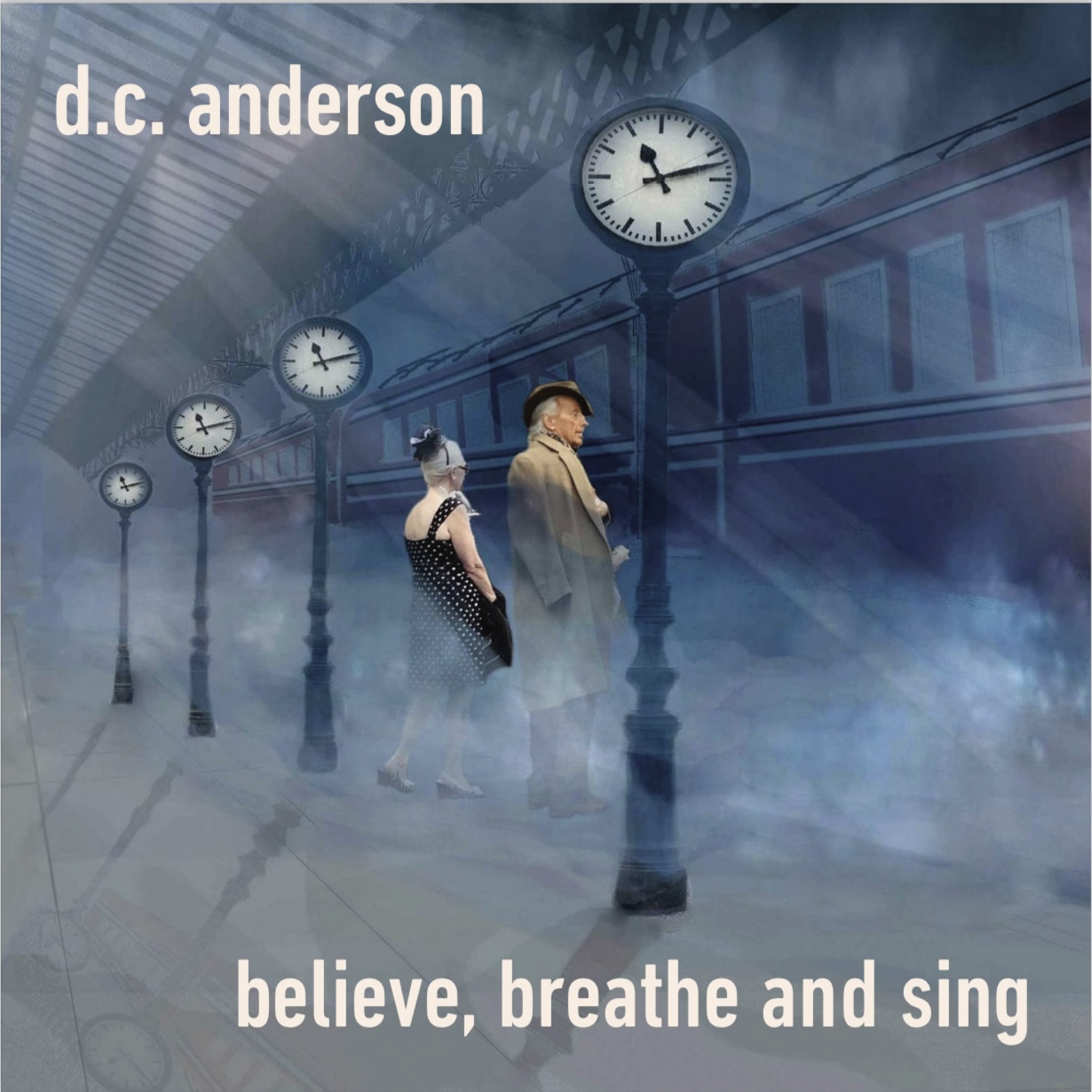
D.C. Anderson – Believe, Breathe and Sing album cover

cover art by Alan M. Richards; image courtesy of D.C. Anderson

Album Review of D.C. Anderson: Believe, Breathe and Sing

I’ve reviewed D.C. Anderson a few times already here at the blog. In 2023, I reviewed his intimate-sounding album House Concert. About a year ago, I discussed Sharing the Night with Darkness, his collection that included a lot of heavy and/or personal life-issue oriented songs, often touching upon difficult subject matter. And just a couple months ago, I covered D.C.’s protest song, “No Kings Live Here,” one of a small series of protest singles he issued this spring. Now it’s time to take a look at D.C.’s October 2024 release, Believe, Breathe and Sing.

The songs on D.C.’s most recent full-length release, Believe, Breathe and Sing, cover a lot of ground, from melancholic and insightful to dark and heavy. Indeed, a whole lot of thoughtful and heavy. And, in a couple of instances, it’s joyful and silly. As I always note, D.C.’s presentation style on almost all of his songs is very stage-like, though not necessarily big-stage theatrical. Sometimes it’s small and intimate, as in a cozy theater where every breath can be heard. The amount of deep songs on this record make it a rewarding listen, but if you’re not at full emotional strength when you begin, it can be a bit overwhelming as D.C.’s voice is so effectively able to delve deeply into every strong emotion of every song, so many of which are weighty and introspective. Beyond that, it’s hard to sum up a 19-song record like this into an abbreviated yet thoughtful review, so I hope you don’t mind that I’ve decided share my thoughts as I go through it song by song.

The album opener – title song “Believe, Breathe and Sing,” is a perfect example of an intimate, soft-spoken (but clearly enunciated and dramatically phrased) song. In this case, the singing turns nearly spoken-word for emphasis. Quite effectively, I might add.

The Alan Schmuckler-penned “Sparrow,” next, is a melancholy number that D.C.’s voice emphasizes with well-placed cracks in the vocals, while the music is smooth. It’s one of the more memorable tracks on the record, exceptionally well-suited for D.C.’s delivery of this sort of soft, heartfelt song.

“Whiskey Blues” is a song from Jahn Sood’s folk opera The Disappearing Man, one of four tracks on this record from that musical. D.C.’s delivery of “Whiskey Blues” puts a solid, unique stamp on the original, taking a rougher-edged tack that, in this case, is very Simon Scardanelli-esque in many ways. Simon has long been a blog favorite, but I can’t recall ever before hearing another artist’s song that captures a similar tone, let alone also with a well-worn, bemused yet sincere delivery. For me, this is a standout track, though in part for that very specific reason.

“A Kiss” follows with some pleasant pianowork supporting D.C.’s subtly soft vocals. “Twenty Twenty Five,” next, is a nice – and, unfortunately, quite prescient – follow-up, as it supports similarly soft-touch vox with an acoustic guitar’s strum. Like the “Twenty Twenty Four” single I reviewed last year at the end of my the Sharing the Night with Darkness album review, “Twenty Twenty Five” is a D.C. Anderson co-write with Luke Wygodny.

Next, in the midst of such serious and/or heavy material, it’s nice when D.C. drops in a silly, playful number like “Fish Fry and Guava Pie,” with songwriter Ritt Henn’s consistent ukelele strum adding to the fun.

D.C. returns to weighty music with the softly-voiced, emotionally-wrought “Ethan and Emily,” then a song, “Love Song to a Friend,” that’s just as heavy but full of humanity and warmth, if still sadly so. And “The Worst Thing We Ever Did” follows with depth that revolves around religious contemplation, kind of tugging upon a thread that was buried in the previous number.

“Oh, My Diana” is a full-voiced, warmly-delivered rendition of the song penned by Matt Vinson and Matte O’Brien for a musical adaptation of Anne of Green Gables. There’s some important, supportive string work on this song. Digging through the credits, I assume this is the contribution of cellist Audrey Q. Snyder.

“Other Mother” is perhaps one of my favorites of the deeper songs on this record. It has a warm, pleasant humanity… and a more clear happy progression and ending than many of the other weighty songs on this album.

“Don’t Put My Baby Down” is slow and soft. It allows D.C.’s voice to soar briefly – but not too loudly – from time to time, as even its pleasantness feels a little ominous.

D.C. returns to The Disappearing Man the next track, this one “Old No. 22,” finally raising his voice to rich power for the first time in several songs. Then he pivots an energetic performance of Bryce Kulak‘s absurd – and absurdly fun – “Pelican,” with vocals, pianowork, and lyrics that are thoroughly entertaining, before returning to two more songs from The Disappearing Man. The first of those, “Sara,” is a rich, broadly-voiced number supported by a pleasant finger-picked guitar, which saddens toward the end. Then “Arms” is much more delicate, ending with “I will follow you as far as life is long,” a lyric D.C. sets down gently at the song ends.

“Funeral Blues” is, lyrically, the poem by W.H. Auden, with music written by Bryce Kulak. That’s some serious stylistic range for Bryce, too, when compared with “Pelican”! Kulak’s musical arrangement takes a much richer, darker tone on “Funeral Blues,” as does D.C.’s voice. David Robison‘s pianowork is a powerful backdrop, with the vocals employing the necessary power to equal the keys on the performance of this number.

“When the Angels Come to Call” features guitar, I believe, that’s picked almost as one would a harp, befitting this number that’s lighter, though no less serious, than much of the rest of the collection.

D.C. ends the record with an even lighter, quite pleasantly instrumented song, “For My Luck, I Suppose.” A song about the good people in D.C.’s life. As the lyricist, I suppose it’s his life, anyway: “Have I told you I love you? If I haven’t, it’s so. The best part of my luck is the people I know. My friends and my neighbors, the truest of hearts. Gentle, thoughtful and kind, equal parts.” And it’s the reason the memory of this album doesn’t seem so dark, when looking back, after completing each listen. In fact, I was a little surprised by its seriousness when I actually sat down to write the review in part because the closing number leaves the listener with a pleasant final thought, a warmth and reminiscence of all the good people in one’s life.

Of course, I love the light songs “Fish Fry and Guava Pie” and “Pelican.” These almost felt like Shakespearean comic relief, silliness to lighten the mood during a drama that’s otherwise full of tragedy. In this case, a lightness to serve as a pause from the album’s seriousness. My other personal favorites on this record include “Sparrow,” “Whiskey Blues,” “Other Mother,” and “Funeral Blues,” all very serious songs – that describes most of this record, after all.

A D.C. Anderson album is always a worthwhile listen. It’s often a journey, both within each song and throughout the record. And you always leave with a few new favorite songs. If you’re even remotely interested in folk music, theater music, or simply exceptionally well-performed songs with thoughtful lyrics, you’ll be glad you gave this album a listen.

More Recently

While I was writing and proofreading this review, D.C.’s new album, Song Stay Sung, was released – just a couple days ago, in fact, on June 6, 2025. I look forward to hearing D.C.’s new release.
Single Review: D.C. Anderson – “No Kings Live Here”

D.C. Anderson – "No Kings Live Here" cover art

image courtesy of D.C. Anderson

Single Review of D.C. Anderson: “No Kings Live Here”

This timely single, D.C. Anderson‘s “No Kings Live Here,” was released on April 4, the day before the “Hands Off” protests occurred in 1,000 cities across the U.S. It would have made an ideal song for the events, if those in attendance knew about it. But it can serve as a reminder and a rallying cry for those who attended.

I’ve seen social media posts, like this one, asking where all the protest songs are. Well, this is one. D.C. notes that “No Kings Live Here” was inspired by the t-shirt U.S. Representative Maxwell Alejandro Frost wore at this year’s U.S. State of the Union address.

On this song, Gantt Kushner mans the guitar, while D.C. sings. D.C.’s delivery, as is his style, is very theatrical. You’d almost wonder if, in addition to being a singer-songwriter, maybe he’s also a highly-regarded stage and screen actor or something. “No Kings Live Here” is delivered enthusiastically, in such a way that it seems as if D.C. is leading a singalong. And that, my friends, is what makes it a good protest song.

Lyrically, the song is a little word-dense, and its storytelling style – really more of a combination of teaching and fact-proclaiming in addition to storytelling – is along the lines of Schoolhouse Rock. Remember the one about how a bill becomes a law? OK, maybe it doesn’t sound like that. But “No Kings Live Here” would still make an entertainingly educational soundtrack for a Schoolhouse Rock cartoon.

Lyrics in the song include “The man who would be king has put democracy on pause. The man who would be king thinks he’s above our U.S. laws” and various versions of the chorus such as “No kings live here. No tyranny, no fear. No kings live here. The Constitution’s clear.” And “No kings live here. We do not serve him whim. No kings live here. We will not bow to him!”

But hey, check it out for yourself. You can watch the lyric video here on Vimeo if you want to learn the song. It’s also handy if you want to sing along while listening. If you’ve been searching for a modern-day protest song, this might just be what you’re looking for.

Album Review: D.C. Anderson – Sharing the Night with Darkness

photo by Sam Pickart; photo courtesy of D.C. Anderson

Album Review: D.C. Anderson – Sharing the Night with Darkness

D.C. Anderson is an accomplished stage and screen actor and recording artist, with a delivery style very much of the stage. If you like Broadway cast albums – or if you like sincere, well-crafted singer-songwriter music – then D.C.’s albums of intimately sung, theatrically-styled offerings are likely to be right up your alley.

Sharing the Night with Darkness is a collection of songs many of which touch upon issues like aging and mortality. It’s an incredibly moving collection, meaning I have to pick my listening moments, reserving this album for times when I’m in the mood to be deeply moved and emotionally affected. For a glimpse into the topics and emotions behind each of the songs on this disc, I’d direct you to D.C.’s Facebook post where he discusses this album.

D.C. is joined by David Robison on piano for some songs, Luke Wygodny on guitar for others, and vocals-only with no accompaniment for still others. Other musicians chip in during one or two songs each: Audrey Q. Snyder (cello) on “Mail Order Annie” and “Such Fine Things” and Lem Jay Ignacio (piano) and Lemy Ignacio (guitar) on “You Do Something To Me.”

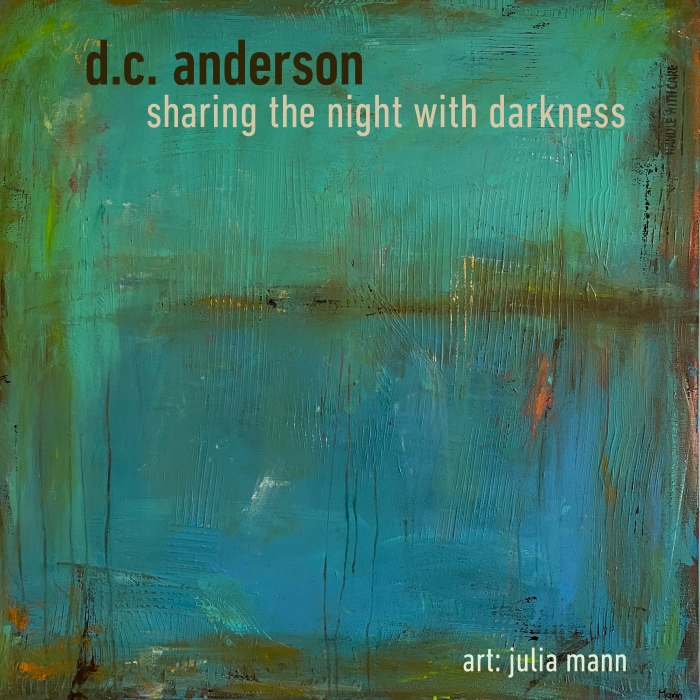
album art by Julia Mann; image courtesy of D.C. Anderson

D.C. opens his heart in the album’s opening song, “Again,” about falling love with his husband over and over again. As mentioned, D.C.’s delivery style is very theatrical, so a touching song like this brings to mind a solo performance on a stage, just the singer in a spotlight, delivering a heartfelt appeal at a crucial moment in the storyline. Or, perhaps, a closing monologue-type song, one that reflects on the play’s happy ending after a night of twists and turns on the stage. Regardless, it’s easy to place this song on Broadway, even though it’s not.

“Market Girl” is a song I enjoy for a very different reason. It’s plucky and playful. As is D.C.’s rendition of Cole Porter’s “You Do Something to Me.”

D.C.’s voice soars on songs like “A Tree” and Harry Chapin’s “Mail Order Annie.”

D.C. serves up serious, powerful stage vocals on tracks like “I Am Anger” and “I Am the Dream.”

“Twenty Twenty Three” is styled more like a folk song, though D.C.’s vocals assert his position as an emphatically emotional troubadour when he plays that role.

Then there are other songs, like his ominous cover of Bob Dylan’s “Dark Eyes,” styled like a sad pub drinking song. Similarly styled, from a pub dirge perspective, is “Sully’s Pail,” an enthralling vocals-only cover of the Dick Gibbons-penned lyric that was put to music by Tom Paxton several decades ago. (You can hear Paxton’s version here.)

D.C. touches upon some heavy topics that can make for some rugged listening. “When I Get Quiet” is thoughtful and pensive. “I’ve Come Looking For You” is heart wrenching, as is “Night, June 1988,” a song with an interesting arrangement that’s split between interspersed spoken-word and musical delivery. “I Must Know You” is intensely delivered from the point of view of someone suffering memory loss. And “Epilogue,” while less difficult than the other songs I mention in this paragraph, is an Andrew Ratshin-penned song about a man looking back on his life from his funeral; it’s less difficult because it’s not anguished and the music is a bit more upbeat. Still, though, a heavy topic.

The penultimate song on Sharing the Night with Darkness is D.C.’s exquisitely voiced cover of “I’ll Never Find Another You.” D.C. notes, in that Facebook link I suggested you read above, that it’s his tribute to The Seekers’ Judith Durham. D.C.’s version is, of course, more melancholy than the original, which is further emphasized by his a capella delivery.

The album closes with “Such Fine Things,” with vocals about as close as you can find to crooning in this collection.

In all, with so many dark and/or heavy songs on this exceptionally crafted album, a particular frame of mind is required to choose to listen to Sharing the Night with Darkness. When that sort of introspection and depth of thought and emotion are what you seek, though, this album offers a well-designed vehicle for that experience.

image courtesy of D.C. Anderson

More Recently

On January 16th, D.C. released the single “Twenty Twenty Four,” planned to potentially be the title track of D.C.’s next album. Recorded with Luke Wygodny, who lent his guitar-playing to the single and shares songwriting credit for creation of the music to D.C.’s lyrics, “Twenty Twenty Four” places a strumming, folky guitar beneath D.C.’s vocals, moving from soft and thoughtful to loud, quivering, and somewhat angry, as it contemplates the power of love to bring an end to war, or at least its power to yearn for peace and its resolve not to stay silent. You can find a lyric video for “Twenty Twenty Four” via this link.

Looking Ahead

Well, there looks to be a new album on its way. Twenty Twenty Four. As of the eponymous single’s release a few months ago, a spring release date was targeted.

If you’d like to catch D.C. in person, he is scheduled to appear with Ritt Henn at noon on June 1st at the Upstream Gallery in Hastings on Hudson.

Beyond that, I’m not sure of the best way to remain abreast of D.C.’s latest goings-on, but a good place to start would be to follow him on social media: Facebook, Instagram, and X.

Album Review: D.C. Anderson – House Concert

D.C. Anderson – House Concert

image courtesy of D.C. Anderson

Album Review of D.C. Anderson: House Concert

This is a cool concept for an album. D.C. Anderson is an accomplished stage and screen actor, and these 11 songs – including 3 on which he’s credited as the lyricist – are enjoyably combined in a house concert-like set; hence, the album title. The performance is stripped-down, with only pianist David Robison for accompaniment, allowing D.C.’s voice to carry the remaining weight, his nuanced delivery providing all the necessary “color” and support. There’s a theatrical delivery to every song on the record; stylistically, it’s the sort of album you might expect from a star of musical theater, an anthology of songs performed as if from Broadway soundtracks, whether or not the songs were drawn from actual musicals.

What better way to kick things off than with Rodgers & Hammerstein’s “Some Enchanted Evening,” which D.C. opens with haunting vocals, evoking images of a pitch-black theater, a performance beginning, with the singer walking into a single spotlight before a silent audience, anxious with anticipation. The voice and piano build over the course of the song, increasingly emphatic. What a great way to kick off an evening, an album, or, of course, a house concert. As you may know, I love a record with well-ordered songs, and this is a strong way to start.

Next, D.C.’s performance of “I Wanna Know You” from Anne of Green Gables is a powerful follow-up, with the vocals-and-piano arrangement giving this recording a much more fragile intimacy than is likely to be easily achieved on a big stage.

“There Ain’t No Devil” brings – believe it or not – a lighter, softer, more relaxed tone to the album, though still very theatrically delivered, which can safely be said about any of this collection’s eleven songs.

The slightly playful airiness continues, as evidenced initially by ivories that sound mischievously tickled at the opening of “While There is Still Time,” offering an enjoyable glide through lyrically heavy waters. Unabashed fun follows, as D.C. enthusiastically delivers the satirical “Loving That Lamb of Mine,” delivering Alan Chapman’s playful lyrics with zest.

D.C.’s voice cracks with emotion next, as he delivers a stirringly serious, slow-paced performance of Todd Almond’s “God is Good.” D.C. is the lyricist for the next number, “Janice and Martin,” which adds a bit more pace and feels perhaps closer to folk – theatrical folk, mind you – than the other songs in the collection.

This House Concert turns playful again, dipping into Song of the South for the ebullient “Sooner of Later,” which is, in fact, a quite proper lyrical follow-up to “Janice and Martin.”

D.C. wrote the lyrics for the next two tracks. First, “Crazy Still to Do,” sounds like it should be my favorite song from an irreverent musical, with cool lyrics like “I’m sorry for what’s missing. I’m missing something, too. But so’s you hear, I’ll make this clear, I’m crazier than you.” With a nod to song ordering, it’s the third of a really well-arranged sequence, both topically and musically.

Next up, “Song for Artists” is a bit more serious and sincere, as it soars musically and vocally, delivering a message of, as you might guess from the song title, thanks to artists. Following, D.C. closes the record with a slow-building, powerful delivery of Susan Osborn’s “Bright Angel,” setting the song down for a soft landing to draw his House Concert to a close.

I’d recommend a beginning-to-end listen of this record. The songs, in order, ebb and flow enjoyably, with tempos (and levels of seriousness) varying throughout. And, after a few listens, certainly you’ll have favorite songs that you’ll want to play individually from time to time, as well. Personally, I’m particularly fond of D.C.’s arrangements and delivery of “Crazy Still to Do” and “Some Enchanted Evening.”

More Recently

House Concert was released in early 2022. More recently, in 2023, D.C. released the album Sharing the Night with Darkness.

Looking Ahead

D.C. will be performing live in Chicago on Sunday, October 22nd and in New York on Sunday, November 12th. You can find time and location details for those performances on the “calendar” page of D.C.’s website; check back periodically as more performances are added. You’ll also find the occasional update about D.C.’s goingson on his Facebook page.