
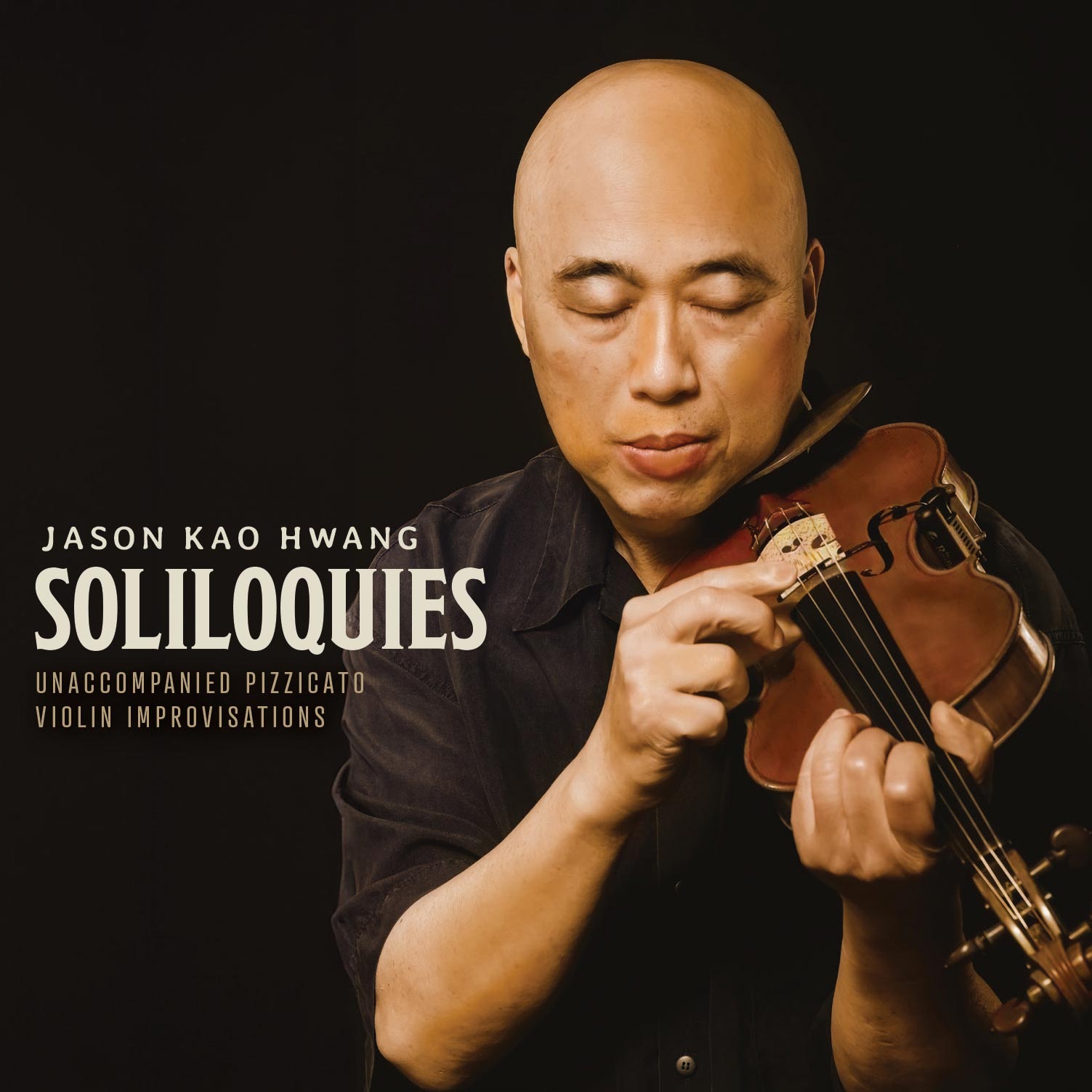
image courtesy of Jason Kao Hwang
by Eric Harabadian, Contributing Blogger
Album Review of Jason Kao Hwang: Soliloquies
Originally from the Midwest and currently based in New Jersey, Jason Kao Hwang is a classically-trained violinist and composer who specializes in a free jazz and improvisational approach to his instrument. He cut his musical teeth in the late ’70s and early ’80s playing with some of the heavyweights of avant garde jazz music such as saxophonist Anthony Braxton, saxophonist/flautist Henry Threadgill, and bassist Reggie Workman. Hwang, who is of Chinese descent, has also been heavily involved in world music that reflects his Asian-American heritage.
That wealth of musical and cultural knowledge is uniquely compressed into a dozen tight and expressive original solo violin etudes and improvisations. In particular, the strings master employs a specific technique throughout the recording called “pizzicato.” It is an alternate manner of playing where, instead of using a bow and swiping the violin strings, the instrument is “picked” or plucked similar to an approach on guitar. It’s a technique that gives the violin and each composition an entirely different and more percussive feel when compared with the way the instrument is primarily played.
In the dramatic arts soliloquies are intimate monologues where a character stands alone on stage to confide their innermost thoughts to the audience. Similarly, Hwang found a way to express himself in an improvisational and solitary context. Each original composition here tells part of a story. It’s a story that is a love letter to his parents and family’s first and second generation immigrant experiences.
The appropriately titled “At the Beginning” ushers in a demure and delicate melody on which the use of subtle pull-offs, trills and fleet-fingered picking is employed. The follow up “Hungry Shadows” develops those initial ideas and spotlights nuanced octaves and space. “Vagabond” navigates the melody in an unorthodox manner, with wit and strategic grace. Angular themes and well thought-out string bends and glissando define tracks such as “Spinning Coins,” “Remembering Our Conversation,” and “Encirclement.” Solo pizzicato in the hands of a sonic craftsman such as Hwang is magical because he refuses to be bound by the chains of conformity. Throughout his musical explorations on this album he makes his acoustic violin sound like a talking drum, flamenco guitar, and an Asian lute-like instrument called a Koto.
Every artist should grant themselves the opportunity to truly express who they are and where they come from. For all the sideman and collaborative work Hwang has done over the years, it’s nice to hear the soloist captured in his natural and familial element. And that’s what you essentially find here. “For the children of war survivors there are conversations with our parents we wished we had and could not,” explains Hwang in the liner notes. “I often wonder about my parents’ vague allusions to atrocities they survived in China during World War II because their trauma was far greater than I can imagine, even now, over 20 years since their passing. In Soliloquies I honor their courage by embracing their voices within mine, to sing into our unknowable silence encircling dreams. I am especially playing for my father, who endured multiple strokes, the last of which took his voice.”
Soliloquies is a dedicated listen and one that, in light of the stories behind each track, will draw you in with its earnestness, subtle delivery and powerful resolve.
 Geoff Wilbur's Music Blog