EP Review: Diablogato – Snake Oil Salvation

Diablogato

photo by Pat Piasecki; photo courtesy of Knyvet

EP Review of Diablogato: Snake Oil Salvation (Rum Bar Records)

Crazy-ass, eclectic, electric, straight-ahead, aggressive, guitar-driven, distortion-laden western rock and roll. That’s Diablogato. And this record is exactly what you’d expect from a leather-clad, axeslinging devil cat! Or perhaps a stray cat possessed by the devil. Indeed, Johnny Custom plays upright bass for Diablogato, partially inspiring my Stray Cats reference, as this music swings pretty well for heavy rock music; maybe the bass plays a role. Custom is joined by Charlie MacSteven on guitar and backing vocals, Jesse Von Kenmore on drums and the inimitable, rough-hewn powerful voice of Drew Indinagaro on vocals and guitar.

“Heavens Gate” kicks things off with an echoing, heavy, angry rhythm thumping straight through grittily howling blues-rock vocals. You may not be able to imagine things will amp up after this opener, but Diablogato is just getting started.

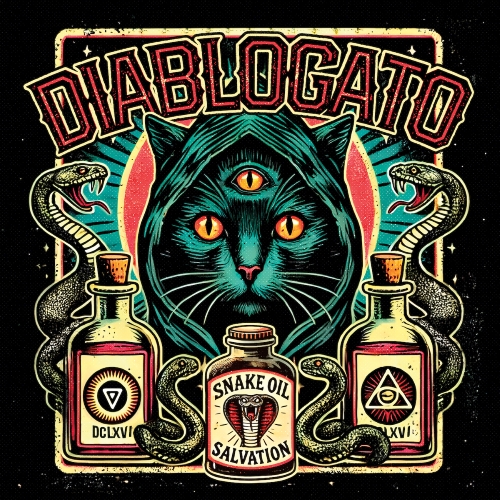
Diablogato – Snake Oil Salvation EP cover art

image courtesy of Knyvet

My two favorite songs on this EP (personal taste, ymmv), in reverse order, are numbers two and three. The first of those two, “Wandering Hearts” opens more airily haunting, like a devil-possessed Johnny Cash song. The “whoa-o-oah” will draw the listener in. What if Chris Isaak’s “Wicked Game” was darker, heavier, and a bit more foreboding but still just as haunting? Then you could pair it with “Wandering Hearts,” though the surf-meets-blues-rock guitar solo during the late-song bridge in “Wandering Hearts” really doesn’t compare to much of anything else.

Third song “Fire and Powder,” my favorite on the EP, amps up the “whoa-o-oah” to the next level, with a frantic, full-speed-ahead energy that’s interrupted only at the halfway-point for an instrumental section that begins slow but intense and slowly ramps up the speed until it returns again to maximum energy level, erupting into a nifty, high-speed guitar solo that runs until the song’s few closing lyrics. The tempo, though? Whew!

Of course, just because those are my favorite tracks, that doesn’t mean I’m dissing the rest of the disc. Au contraire, six songs isn’t nearly enough Diablogato for one sitting!

“Jet Black Night” is a slower-paced but still heavy, bluesy-groovin’ heavy rocker. “July 1969” has a steady beat, some country twang with an almost folk-influenced heavy rock vocal, meaning it harkens back a bit to that psychedelic rock era, and a raucous punk-but-it’s-too-smooth-to-be-punk attitude. And “Lost Highway,” which closes the EP, opens with a mellower, more bluesy rock vibe before picking up the pace with energetic rock, except for the instrumental guitar bridges, which are slower, a bit bluesy and haunting, and very heavy and plodding, much like late ’70s/early ’80s heavy metal – pre-big hair, real heavy metal. It’s a cool blend of styles, much like this entire Diablogato album, making it a fitting conclusion to a fantastic six-song listen.

In the end, if, based on Snake Oil Salvation, I had to compare Diablogato to other bands I’ve reviewed at the blog over the years, I’d say they belong in the desert southwest, nestled between Angie & the Deserters and Love and a .38. In other words, as the middle band in a kickass rock ‘n roll triple-bill with two other artists that give off a similar vibe, arranged from lightest to heaviest, with Diablogato perhaps residing closer to the heavier band. Regardless, Diablogato is a very original, thoroughly engaging must-hear, especially – but not exclusively – for guitar-based rock fans.

Album Review: Neale Eckstein – Never Too Late

Neale Eckstein sitting in a studio, holding an acoustic guitar

photo courtesy of Broken Jukebox Media

Album Review of Neale Eckstein: Never Too Late

Neale Eckstein has been a part of the metro Boston music scene for as long as I remember. His Fox Run Studio has recorded numerous projects. His Fox Run Concert Series has hosted top artists from all over since the late ’90s. I’ve seen Neale share photos from his Kerrville Folk Festival visits for years. It never dawned on me that he hadn’t ever released a full-length album as a singer-songwriter. Until October 2024, that is, when Never Too Late came out. Digging deeper into Neale’s bio, he’s a retired pediatric dentist (I already knew that), who didn’t take up songwriting until he was nearly 60 (that’s something I didn’t know). Although he released an album with “Neale Eckstein & Friends,” he only performed lead vocal on one song, so that doesn’t count. In 2019, he released a short EP. But finally, at age 75, Neale released his first full-length record. I have one problem with that – there’s no way Neale’s 75! As they always say, I guess – music keeps you young!

Neale’s songwriting is impeccable. And his voice is earnest, honest, and a bit gravelly, well-suited for the observational (or participatory) storytelling music at which he excels. If I were to paint a picture for you, Neale’s vocals are the sort you’d expect from a grizzled old cowboy, singing expansive western-folk music while sitting around a campfire somewhere in the dusty southwest.

Never Too Late contains many memorable lyrical moments, a nod to Neale’s songwriting prowess and to his honest, heartfelt delivery. Vocally, again, Neale’s voice is hoarse, gravelly, forthright, and emotive, helping him attain that folk music storyteller role on pretty much every song.

The first three songs on the album run the gamut of song topics. “Masterpiece” kicks things off reminiscently about parents cherishing the memories and times spent with their young children. “One Month Crazier” is a fun song about being on the road; I mean, it’s sung kind of sadly, but it’s packed with clever wordplay. And “Red Swivel Stool” is a song about growing up in segregated Durham, North Carolina, through the eyes of a child who notes, “Some sat in the front. Some sat in the back. And some couldn’t sit anywhere at all. Some went to the front door. Some went to the back. Didn’t make much sense when I was small. Didn’t make much sense at all.” Of course, since the song is sung as if looking back as an adult, the final line of the song revises the ending to that chorus to “Still don’t make no sense at all.”

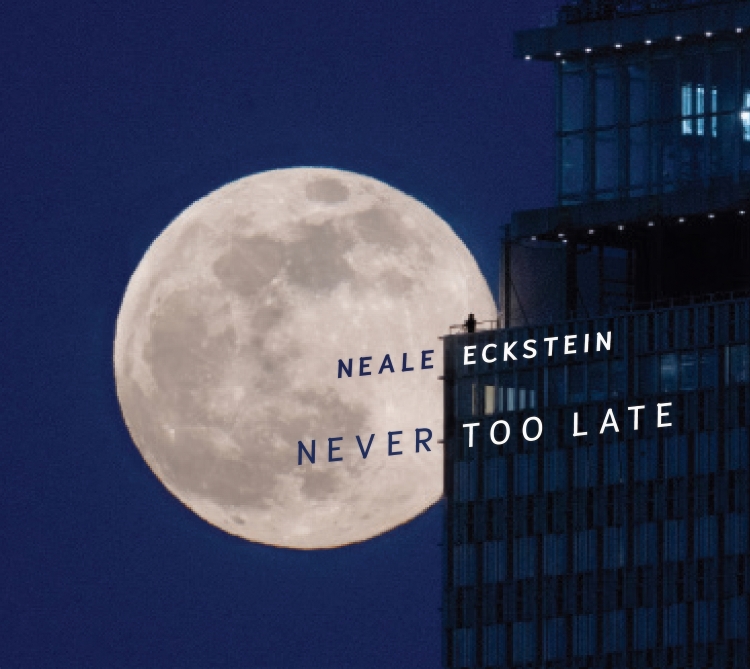
Neale Eckstein – Never Too Late album cover

photo courtesy of Broken Jukebox Media

A couple songs later is “Devil’s Gate,” a very western-sounding song about the Pony Express, with a rhythm sounding very much like hoofbeats.

“Like a Poem Needs a Rhyme” is a sweet, heartfelt song, sung as a duet with acclaimed, Austin-based folk-Americana singer-songwriter BettySoo. The song is soft, slow, simple, and straightforwardly from the heart. The album notes say it was inspired by Kris Kristofferson, and you can really hear the influence in this track.

“Big Shining Circle” is a steady, soft ode to moon photography with some nifty, occasional guitar twang keeping things interesting. That’s notable for a couple reasons. First, it’s the only song I’ve heard that focuses on this particular subject, so it’s likely to become the all-time favorite song to a small but very devoted following. Also, well, check out the album cover. Neale loves taking pictures of the moon, and his passion shows in both this song and the record’s cover art.

“Stormchaser” is slow and haunting, a storm-themed song about relationships, that includes the particularly cool lyrical turn-of-phrase: “But I know that I will never leave when I am warned. Been running into the wind since the day I was born… a stormchaser.” The music, too, accompanies the feeling of eerie calm right before the storm arrives, a little unsettled and echoey at times.

“Fall From Grace” and “Gonna Get It Right,” back to back, are songs Neale notes are inspired by friends’ breakups, and they carry the appropriate gravitas but with slightly different melodies and vocal/musical approaches, so this is the part of the record to turn to if you want to hear a couple tightly-written and well-performed songs about this particular topic.

The album closes with “Messy Bed,” a slow, powerful song – sung, of course, with a soft, gravelly, truthful-sounding voice – based on the message of the fact that it’s never too late. For Neale’s first full-length release after a lifetime of experiences, it’s such a fitting way to end this record, as the chorus sings: “So don’t be afraid of the messy bed you made. No, don’t be afraid ‘cause it just gets in the way. And sometimes the world makes you wait, but the truth is, it’s never too late.” Words to live your life by in the form of, perhaps, an encouraging song to help you do just that.

In all, this 14-song collection is soft, well-written, and excellently-performed. Folk music fans, in particular, are likely to really enjoy this record, though all of us are likely to latch onto at least a song or two that really touches us, so it’s probably worth at least one listen to everyone; many, many more to core fans of this genre because it’s a great disc.

What’s next? Well, I believe there’s a “Fox Run Five” recording in the works – the “Fox Run five” being Neale’s core set of collaborators – so watch soon for a Fox Run Five double-vinyl release, as Neale discusses in this Facebook video.

Album Review: High Lowdowns – Honey Moonshine

High Lowdowns

photo by by Kathy Parella; photo courtesy of the High Lowdowns

Album Review of High Lowdowns: Honey Moonshine

New England’s High Lowdowns hail from Worcester, MA and Rhode Island. The bulk of the band’s sound is an energetic, kinda twangy Americana, though the band covers a breadth of musical real estate, coming off as nearly an alt-rock band on at least one track.

The High Lowdowns are Gregg Levins (vocals, guitar, Farfisa organ, harmonica), Joe D’Angelo (lead guitar, bass) Scott Kenyon (drums, percussion) and Julia Benoit (vocals). Honey Moonshine is the band’s second full-length release, following its self-titled 2023 debut.

Honey Moonshine begins with perhaps the three most quickly catchy songs on the album. (It’s always smart to start a record with the songs that connect with listeners the quickest!)

High Lowdowns – Honey Moonshine album cover

image courtesy of the High Lowdowns

Album-opener “So Much More to Life” reminds me, right off the bat, of a long-form version of a Hee Haw song. I mean that in a good way, of course. It’s instantly catchy with a sort of down-home wisdom message and delivery: “So leave all your troubles and leave all your strife. Believe me when I tell you there’s so much more to life.” It’s one of those songs that you initially think must be a cover because it feels so comfortable and familiar from the first note. But it’s not. It’s simply a good, catchy song.

“All Twisted” follows, another lively song feels like something the B-52’s might record… if they were an Americana band. Be aware, you will soon find yourself singing along with the chorus. But there’s nothing NSFW there, so don’t worry.

Next up, in the three-hole, is the album’s title track. “Honey Moonshine” slows things down a bit, with an almost haunted vibe, as you might expect from a Love Love song, but without the dark subject matter. I mean, it’s not a happy song by any means; quite the contrary, the music fits the mood. But it’s just a normal-type of sad.

Saying that the first three songs are the quick-grabbers is, by no means, meant to show disrespect to the rest of the disc. The whole 10-track record is a fantastic repeat listen. It’s just that the first two singles, if you’re thinking like a record company exec, should probably come from the album’s first three tracks.

High Lowdowns

photo by Steph Benoit; photo courtesy of the High Lowdowns

The very next song, in fact – “The Devil You Embrace” – turns a really nifty phrase in its chorus: “We all got demons now to twist and turn our fate. They’ll walk you down pathways where temptation lies in wait. It ain’t easy but you’ll find, at the end of the day, it’s only you that gets to choose the devil you embrace.” I’m not sure if I’d describe that more as “cool” or “badass,” so I’ll meet somewhere in the middle. That chorus’ lyrics are “coolass”!

“Wilted” is another of my favorites, a moderately-paced danceabilly-ish number. And it’s followed by “Turn This Thing Around,” which is the song I mentioned being a little reminiscent of alt-rock – with an Americana influence, clearly, but it’s a distinctly different sound – albeit it enjoyably so – from most of the rest of the collection.

Those of you who favor “All Twisted” are likely to consider “Can’t Shake You Out” your second favorite track. It’s not a soundalike by any means, but it bops along with a similarly energetic tempo and delivery style. Meanwhile, I could say the same thing about “Soul Tied” relative to “Honey Moonshine.”

The record closes with “Sun Sets West,” a mid-tempo song that maintains a steady, moderately energetic tempo. Indeed, the core sound and delivery of the main portions of the song are relatively mainstream, rich Americana, but notably, the opening – and a late-song solo – have a slightly airy-instrumented structure that hints at a western style. It’s a fun closing number for Honey Moonshine, an enjoyable collection of songs that fit well together yet offer enough variety to provide an interesting full-album listen.

It’s also worth noting that the High Lowdowns’ style seems as if it would translate very well to a live performance, so it’s worth seeking out the band’s upcoming concert calendar. Perhaps, follow the band’s Facebook page for future gig announcements.


Album Review: Itamar Erez & Hamin Honari – Migrant Voices

Itamar Erez & Hamin Honari – Migrant Voices album cover

image courtesy of Dog Ranch Music PR

Album Review of Itamar Erez & Hamin Honari: Migrant Voices

As you know if you’re a regular reader, I like a good instrumental album from time to time. Well, Israeli guitarist Itamar Erez and Iranian percussionist Hamin Honari deliver a great one with Migrant Voices. Erez and Honari met through the Vancouver music scene and have performed together in and around British Columbia. They applied for a Canada Council grant to record this album.

Itamar Erez

Itamar Erez; photo by Diane Smithers; photo courtesy of Dog Ranch Music PR

On Migrant Voices, Erez and Honari combine Erez’s softly meandering, often rhythmic strumming and picking with Honari’s broad array of percussion sounds and beats to create a nifty jazz collection that would be equally at home in a theater setting or at a venue with more of a coffeeshop vibe. In a personal setting, the Migrant Voices album is equally suitable as music for relaxing after a stressful day, music in the background to help feed a bit of relaxation into a stressful day, or in a number of other situations.

Hamin Honori

Hamin Honori; photo courtesy of Dog Ranch Music PR

The title track, “Migrant Voices,” was the only song that was pre-written before the album was recorded. The rest of the songs were “freely improvised without a plan” while in the recording studio, though the artists note that “Forgotten Sands,” while it began as an improvisation, was honed by recording several versions and includes some overdubs. Of course, as the end result is such an enjoyable listen, it seems like a solid artistic choice, just as years of practice and years of performing together by Erez and Honari served as the basis of their improvisation in the first place.

From the steady progressions of “Migrant Voices” to thoughtful use of open space during transitions in “Embrace” and the artistic intertwining of the instruments through out the album, Migrant Voices remains relatively hushed in tone, which is why it’s a great companion for such a variety of experiences, from thoughtful, in-depth listening to accompanying other activities. Throughout, this record is an intriguing listen and an excellent addition to any music collection.

Album Review: Erin Ash Sullivan – Signposts and Marks

Erin Ash Sullivan

photo courtesy of Erin Ash Sullivan

Album Review of Erin Ash Sullivan: Signposts and Marks

Erin Ash Sullivan serves up an excellent folk music album with Signposts and Marks. The music bed is full and rich, moreso than many folk records, providing a collection of songwriter-driven storytelling songs that can appeal to a broader audience than the more simply-produced acoustic singer-songwriter fare with which she shares a genre.

Erin Ash Sullivan – Signposts and Marks album cover

image courtesy of Erin Ash Sullivan

Erin’s voice is strong, emotive, and varied – she’s a heckuva singer even without the “hyphen-songwriter” attached. But she’s also quite a lyricist, utilizing relatably descriptive phrasing to paint pictures that make an unusually broad range of topics come to life on this record.

Erin opens with “Goat on a Stone Wall,” a song whose twangy-picking opening slides into one of the more typically rich-folk sounding songs on the record. But it also suggests this record is something a little different than you might have initially expected, carrying quite a bit of tempo throughout, showcasing an impressive vocal range, volume variance, and nimble phrasing.

“Rest Stop Bird,” next, features a semi-haunting chord pattern that reminds me a little of a Shawna Caspi song, especially early on, as it uses the imagery of a bird at a rest stop to convey some deeper thoughts, pleasantly, and catchily.

Erin Ash Sullivan holding a guitar on the steps of building

photo courtesy of Erin Ash Sullivan

“Baltimore” is worth noting, as it’s an exceptionally soulful number, but especially because it’s one of those songs you’ll be sure you’ve heard before. This has gotta be a cover, right? Nope. Instant classic. Some of my favorite lyrics on the entire record, in fact, come in this song: “‘Cause it’s the loved ones that take it the hardest when the actors stop reading their lines. When there’s a twist in the plot, whether they like it or not, all along they’ve been seeing the signs.” There’s so much packed in there, particularly within the context of the song, but no, I’m not going to share more of this song’s lyrics in this review. You’ll have to see and hear for yourself.

“One Time I Stole a Book” is softly and, not surprisingly, confessional, sporting guitarwork that sounds a bit like rain softly hitting the window. It’s a song about Erin’s grandparents, wistfully touching upon life’s little moments, perhaps turning points, with the lyric “give us grace to know the signposts and the marks,” from which the album title is drawn. And yes, Erin explains why she stole the book.

Erin Ash Sullivan

photo courtesy of Erin Ash Sullivan

“Winter Walk” is musically off-kilter, suitably accompanying the more disturbing song content. Give a listen, and then again, and keep thinking to yourself, “the lyrics say what?” For one thing, “two sets of prints out and one set home.” But I must say no more. The songwriter might already suspect I know too much.

“Eat the Pie” is another favorite. It’s a playful, cheerful song about reaching for the brass ring, just going for it, all based on the songwriter’s “tiny voice inside [her] head calling out to [her], ‘Eat the pie! Eat the pie!'” You’ll be cheering for the “nerdy bookish weirdo who was cut from every team,” and your anticipation will be rewarded. Not just by the lyrics’ payoff; you’ll also be treated to not-quite-four-minutes of fun, creatively-worded, whimsical listening enjoyment, almost certainly ending with a smile on your face.

Erin Ash Sullivan performing at Falcon Ridge

photo courtesy of Erin Ash Sullivan

“Don’t Want to Keep Score” is sweet, serene crooner’s waltz that belies its topic of the toxicity of arguments, if you stop swaying to the music long enough to notice the lyrics.

The final three songs are parent to child themed. “We Walk the Flats” is sweet song about the passage of time, though, of course, more about walking on the beach. “How It Should Be,” next, is also heartfelt and wistful. And the record closes with “Before You Go,” a slice-of-lifer about savoring moments.

The twelve tracks of Signposts and Marks are richly textured, lyrically clever songs, delivered by Erin via impressively rich musical arrangements and an exceptional vocal range. If you like singers or songs – and why are you reading a music blog if you don’t? – then you should give this record a listen.

EP Review: Kristian Montgomery and the Winterkill Band – Prophets of the Apocalypse

Kristian Montgomery and the Winterkill Band – Prophets of the Apocalypse cover photo

image courtesy of Kristian Montgomery and the Winterkill Band

EP Review of Kristian Montgomery and the Winterkill Band: Prophets of the Apocalypse

Kristian Montgomery is an Americana-tinged rock ‘n roll savant. Despite the high expectations in place every time I listen to a new Kristian Montgomery and the Winterkill Band recording, once again, Kristian does not disappoint. And you know, I don’t even worry about the possibility anymore.

The first single from this record, “Leaving Texas,” was released a several weeks in advance of the EP. It’s a friggin’ masterpiece. You know how sometimes you hear a new song but it sounds as if it’s a long-time favorite that’s already a big hit. That’s “Leaving Texas.” Big sound, jangly rolling guitar line, powerful vocals, monster hook, and singalong lyrics: “I’m just leaving Texas, and if I live I’ll see you at home.” If you typically think Americana music is too bland for you, you’ll hear a song like “Leaving Texas” and think to yourself, “Wow, maybe I do like Americana music.” Then you’ll listen to almost any other Americana artist, whose music just lies flaccidly on the record, and realize that, no, you do not in fact like Americana music, you just like the genre’s very best artists, like Kristian Montgomery and the Winterkill Band. Unprovoked attacks on Americana music aside, I have discovered that Kristian always has at least one “how is this not a mega-hit?” songs on each record, and “Leaving Texas” is that song on Prophets of the Apocalypse.

Kristian Montgomery and the Winterkill Band – "Leaving Texas" single cover art

image courtesy of Kristian Montgomery and the Winterkill Band

So far, “Leaving Texas” has remained my favorite track on this EP, but another truism about KMWKB albums is that pretty much any song can creep up on you and be your favorite at a later date, sometimes a different one every day, so don’t sleep on the rest of the EP. As if it would let you.

The following song, “That Bitch Done Broke” is a dense, noisy, sidewinding swamp-rocker. Rather, “rockin’ swamp-blues boogie,” as I called this style in my review of KMWKB’s A Heaven for Heretics. “That Bitch Done Broke” is a heavy-sounding example of the core sound behind much of Kristian’s music. And it’s addictive.

“Rock That Doesn’t Roll” adds a lot of classic guitar-blues flair to that swampy sound, while slipping some rhythmic choppiness into the recipe. And is that cowbell!?! Whether it’s actual cowbell or a similar percussion instrument, that’s just cool af.

“Cold Day in Hell” opens as a bit of a squealing psychedelic rock song before settling into a powerful, classic rock-influenced, arena-worthy, straightforward blues rock number that’ll have the audience singing along with “cold, cold, cold day in hell.”

The EP closes with “Foolish Devil,” a steady, plodding, emotionally pleading number delivered in that cool, blues-rock-country, kinda swampy style Kristian performs so well. And guitar fans will like the long, bluesy, wailing solo shortly past the song’s midway point. A song that drips in coolness, “Foolish Devil” is the perfect way to end this sidewinding, fully engaging record.

You can find Prophets of the Apocalypse here at Spotify and here on Bandcamp.

EP Review: Silveroller – At Dawn

Silveroller

photo courtesy of BJF Media

EP Review of Silveroller: At Dawn

Are you a Zeppelin fan? A Deep Purple fan? A Cream fan? Maybe Jefferson Airplane? Well, have I got a band for you to blast while enjoying your lava lamp and black light posters! Silveroller seems to have stepped straight out of the psychedelic classic rock era, carrying all those influences but still creating a sound all its own, a sound that would have been all over ’60s/’70s album-oriented rock radio.

That’s not to say there aren’t other influences, as well, I could hear Silveroller sharing the stage with bands ranging from the Rolling Stones to the Black Crowes, who themselves were a ’60s/’70s throwback band when they hit it big in the ’90s. Indeed, Silveroller’s At Dawn EP opens with a funky, pounding, howling rocker entitled “Black Crow” (coincidence?), a song whose mix of guitar and organ helps give it that ’60s/’70s sound. “Hold,” following, is basically a nearly-four-minute vocal-and-instrumental jam that ramps up halfway through to the line “and I believe that freedom has got a hold on me” before pausing to take a breath, then erupting in raucous instrumental cacophony. (And repeats.)

Silveroller – At Dawn album cover

image courtesy of BJF Media

“Ways of Sailing” starts out by slowing things down in an almost Allman-esque way, but it only stays mellow for the first minute and a quarter. Indeed, Silveroller can’t seem to resist amping things up to a power-rocking beat, tempo, and volume, building to a wall of musical noise, at least from time to time. There is a bit of late-song harmony in this song that’s a preview of what’s to come later. But the band’s jam-band tendencies are only briefly resisted.

“Turn to Gold” is more of a straightforward blues-rocking wailer. It’s clearly a ’70s-styled blues rocker, but it’s a little less musically intense than any of the preceding numbers. “Other Side” follows in a similarly bluesy rock vein but its thumping rhythm is intermingled with some almost choir-like harmonies. Although I’m sure the first five tracks kill live, the finesse of “Other Side” is a nice contrast – it spends a lot less time being cranked up to 11 than the prior songs, and it even has a less cluttered late-song guitar solo – making it my second favorite song on At Dawn.

Silveroller

photo courtesy of BJF Media

Album-closer “Come On, Come In” is absolutely, definitely, undeniably my favorite Silveroller song. Again, the finesse appeals to me. The vocals soar but still retain an edge. There’s some serious classic rock guitarwork that carries the middle of the song. And there’s an uplifting, almost Gospel feeling to much of the song, the way the song builds to power and sustains but with a full, kind of airy vocal. Trust me, rock fans – this song’ll give you chills.

To be honest, I almost just reviewed “Come On, Come In,” which was released as a single in late 2023, because it’s such an amazing song, but then I gave the EP a few listens, and beginning to end, At Dawn is a helluva rock record, one you’ll enjoy from beginning to end and a collection deserving of a full review. And just because my favorites came at the end of the disc doesn’t mean yours will. But from a holistic standpoint, it’s nice that Silveroller provided a comparatively soft landing after front-loading the EP with so much power.

EP Review: Nate Perry & Ragged Company – The Otherside of Everything

Nate Perry & Ragged Company press photo

photo by Shivohn Fleming; photo courtesy of Knyvet

EP Review of Nate Perry & Ragged Company: The Otherside of Everything

You’re gonna dig this record! Nate Perry & Ragged Company bring a big country sound and a little alt-rock energy to what’s primarily an energetic Americana style on The Otherside of Everything. Kind of R.E.M.-era Athens meets alternative country’s Nashville. It’s a brand of energetic Americana that seems to infect the standout Northeast Americana outfits much more than its does the best of the genre I hear from other parts of the country. Yeah, I know, regional stylistic variances can be weird that way.

The EP-opener, “Maria,” kicks things off with jangly electricity, a steady rhythm, and a full rich sound, delivering a song that sounds like you might hear it on the radio, approachable for a broad audience.

Nate Perry & Ragged Company – The Otherside of Everything cover art

image courtesy of Knyvet

“All I Need” is a lot more twangy, with a bit of a rockabilly flavor – or maybe that’s old-school country music I’m hearing. The energy level and pace are persistent and just a little uncomfortably fast, thumping along festively; you wonder how the band keeps its breath. So, yeah, maybe this song doesn’t have quite the same crossover appeal as “Maria,” but it’s more guaranteed to be a huge hit among fans of core style because, yowza! I mean, whew!

“Another Day” is another alt rock-meets-Americana number. A not-quite-anguished vocal wail punctuates the lyric “I woke up feeling good, but the feeling passed.” Ya gotta dig that lyric! Stylistically, what if John Mellencamp rocked along with the grainy, barely-constrained energy of a rollicking Bruce Springsteen song? Well, its sound might be something like this.

“Evergreens” slows things down a little. The style and pace of the song immediately make me think of what its music video might look like. I’m picturing a slightly faded film-like appearance, probably with very obvious black dots and scratches on the video, as if it’s old and slightly damaged. The view would be framed by the interior of an old pickup truck, looking out the window watching the countryside roll by. Well, think of that video, then imagine exactly the song that might be its soundtrack. The song itself is about looking back in time, imagining what was, reminiscing a bit but also wishing you could change some of what transpired. It’s a cool song.

Nate & Company wrap things up with “Preacher,” a bluesy complaint with wailing guitars to match the sorrowful vocals.

I’d slate “Maria” and “Another Day” as the songs that headline the most-likely-to-be-hits category, but what do I know? The whole EP is strong with enough stylistic variance – all offshoots of Nate Perry & Ragged Company’s core sound – that it’s one of those records where listeners’ favorite songs are likely to vary significantly. So check it out, choose your own favorites, and enjoy.

Album Review: Anthony Geraci – Tears in My Eyes

Anthony Geraci promo photo

photo by Marilyn Stringer; photo courtesy of Anthony Geraci

Album Review of Anthony Geraci – Tears in My Eyes (Blue Heart Records)

I love a good blues piano player, and Anthony Geraci is one of the best. Tears in My Eyes is Geraci’s second release on Blue Heart Records. On this record, Geraci is joined by guitarist Barrett Anderson, bassist Paul Loranger, and drummers Marty Richards and Kurt Kalker. Vocals are most often handled by Sugar Ray Norcia. And Mario Perrett (saxophone), Drew Davies (saxophone), and Anne Harris (violin) all make appearances, rounding out Geraci’s all-star line-up.

Geraci’s rolling keywork and Norcia’s gruff, enthusiastically downtrodden, steady vocals drive album-opening “Broken Mirror, Broken Mirror,” a perfect introduction to this soulful blues record.

Peppy instrumental “Owl’s Nest” follows, with a groovy, hip rhythm supporting Geraci’s adept keywork and Davies’ prominent saxophone. It’s very likely my favorite instrumental on this album, feeling more jazzy than blue, as Tears in My Eyes showcases its musical breadth.

Anthony Geraci – Tears in My Eyes album cover

image courtesy of Blind Raccoon

The title track is up third on this record. Barrett Anderson handles the vocals on “Tears in My Eyes”; his tone blends well with Geraci’s energetic ivorywork and, in a couple of spots, with Anderson’s own small guitar runs. “Tears in My Eyes” is mainstream enough to fit well on adult contemporary radio alongside soft rock songs, perhaps alongside one of Chicago’s hits or even, with a nod to the guitar riffs, a softer classic rock number. I’d consider “Tears in My Eyes” to be the most likely multi-genre crossover song on this record.

The whole album is solid, and it’s a fun beginning-to-end listen, but I’ll stick to a few of my personal favorites the rest of the way. (Your favorites may differ.)

“Judge Oh Judge” is an interesting standout, with Norcia’s vocal delivery, plentiful saxophone fills, and old-school, traditional pianowork recalls the sort of music you might expect in a Prohibition-era speakeasy. Really cool stuff!

The piano-playing on instrumental “Oh No” reminds me a bit of Blog favorite Bob Malone, with saxophone offering some playful back-and-forths.

Though it’s not an instrumental, the pace and tempo of “Ooeee” is consistent throughout, offering opportunities for the musicians to show off, riffing off the steady rhythm line, and whenever the “ooeee” vocal appears, I could easily hear the audience singing along. It’s a cool song, and I bet it’s a big crowd favorite when performed live.

“Memphis Mist” stands out, as the addition of a violin adds a unique flavor to this instrumental that strolls along like a walk through a quiet cityscape. Perhaps, I guess, that city is supposed to be Memphis in the mist. (I’ve never been to Memphis, so in my mind’s eye I picture New York, walking alongside Central Park.)

After the rollicking, modest-tempoed blues rocker “Witchy Ways,” the album closes with a pair of mellow numbers, “Now What” and “Lonely Country Road Blues,” the latter fully instrumental, to set the listener down with a soft, blue landing.

The musicianship on this record, beginning to end, makes it an enjoyable, easy listen. Blues fans of any ilk should check it out. And, of course, keep an eye out for any opportunity to see Anthony Geraci perform live. From this record, I can tell that the breadth and depth of his pianowork would be mesmerizing in a performance setting.

Album Review: Viruette – Your Lacuna

Viruette band photo

photo by Jimmy Del Ponte; photo courtesy of Viruette

Album Review of Viruette: Your Lacuna

Viruette is a Boston-based indie rock outfit with a very cool, uniquely original sound. I dug into Viruette’s off-kilter delivery last year in my review of the band’s EP Waylaid in Aspic. Well, Your Lacuna is thirteen tracks of offbeat alt-rock uniqueness, allowing Viruette to explore more song formats, vocal patterns, and stylistic influences. It’s a feast for the ears. And hellish to try to describe. (Yeah, um, thanks for that, guys.) Seriously, though, if anyone ever approaches this sound, now I’ll be able to say “well, they sound kind of like Viruette.” So who does Viruette sound like? A little bit of a lot of people but not a lot of anyone. Tuneful, lyric-driven, progressive/experimental alt rock, I suppose. I’m really just trying to avoid repeating what I wrote last year, but what the heck, Viruette’s music is, as I said in my Waylaid in Aspic review, “long form, loosely structured, tunefully-sung musical poetry with an edge.”

Viruette – Your Lacuna album cover

image courtesy of Viruette

Viruette is Harry Bee (vocals/guitar), George Heffernan (bass), and Andrew Ring (drums), with Harry the songwriter for most of the tracks on Your Lacuna, with George also writing a couple songs.

Like a baseball team giving their starters a night off, Viruette uses an opener, the 38-second, mildly floating table-setter “I Bloodied My Fingers,” to kick things off on Your Lacuna.

“You Are the Belletrist” brings on the first real dissonance and frantic vocal delivery, very clearly diving into Viruette’s trademark style, a bit frantic with tempo changes, unique musical interludes, and a raw, frenetic energy.

The first single from this album, “Big Fat Nothing,” one of several favorites in this collection, comes next, featuring one of my favorite lyrical runs, “I vomited twice at Euston and once in bed.” The song’s combination of topics and very-on-brand cadence-driven vocals in which thoughts, lyrical phrases, and vocal phrases are matched up at best randomly… well, that’s what you’ll come to expect and enjoy from Viruette. It makes the band unique and fun to listen to.

“Detach” combines Viruette’s style with a jazz lounge vibe. The press release says bossa nova, which is a great description, but one that escaped me until I read the promo material. I’m guessing this song has the most memorable lyric on Your Lacuna; namely, “You are the best ex-Soviet lesbian I ever met.” Top that!

Viruette band photo

photo by Jimmy Del Ponte; photo courtesy of Viruette

“Something for the Dread II” takes the mood down a bit, but “Faceblind” brings the energy right back up with a really fun mish-mash of lyrics that… well, I’m not gonna turn this review into a collection of my favorite lyrics. Just listen for the lyrics when you hear these songs.

Viruette continues through the rest of the record by altering tempos and moods, with experimental music arrangements and well-placed use of dissonance supporting its creative, lyric-heavy vocal delivery.

Several more favorites populate the back half of the record. For example, there’s the floaty, not quite dreamy “Capture,” which might have the best shot at crossover success with ’80s/’90s mainstream alt-rock fans.

The album’s second single, “Lamenter,” is airier and more jazzy than most songs on the disc but features cool subject matter and a word I actually had to look up. “Threnody.” So much cooler than “lament.” Plus it sort of rhymes with “remedies,” which made it the perfect choice for this song. (If “threnody” starts finding its way into my writing, now, Viruette, it’ll be all your fault!)

“Maimed” is another standout song, probably the one song on the record I sway along with. And I’m now singing along with the lyric “in a recursive way.” Yes, in falsetto, obviously. But the more obvious singalong lyric is “I’m getting maimed again.” Though not entirely standard, the song structure of “Maimed” may be the most straightforward on the record. I know I love Viruette’s uniqueness, but here they prove they could clearly excel at more standard alt-rock fare. (Keep in mind, this would be the least standard song on most of those bands’ records, so “normal” is a relative term.)

“Anhedonia” and “Wrecked Car” close the record, the final two of the thirteen unique songs, with Viruette’s original sound not quite like any other you’ve heard, yet not so far outside musical convention to make it truly alien. In fact, if you’re going to become a Viruette fan, it’s probably because you dig the band’s one-of-a-kind overall sound. It’s interesting from the start, then it grows on you. Plus, beyond just being a cool recorded listen, Viruette’s style suggests an exceptionally fun live show, particularly at a seedier-than-you-might-think college rock venue. Viruette’s Instagram account mentions a couple opportunities to see the band live in the near future. Check ’em out!