

photo by Clay Patrick McBridge; photo courtesy of UMe
Album Review of Bob Seger: Face the Promise (Expanded Edition) (Capitol/UMe)
20 years ago, I had recently stepped away from music journalism – and new music discovery in general – so I missed the release of Bob Seger‘s Face the Promise. It was a strong album for Seger, debuting at number four on the Billboard 200 chart and achieving RIAA platinum certification in just three months. Flash forward, and recently, in September, Capitol/UMe celebrated the album’s 20th anniversary with a 16-song “expanded edition,” featuring three previously unreleased songs and one track that had been an exclusive-to-iTunes bonus track, “Red Eye to Memphis.” Audiophiles will also appreciate that this release is also the album’s first-ever 2 LP vinyl release. And more than just a straight rerelease, even the original dozen tracks on this edition of Face the Promise were newly remastered by longtime Seger mastering engineer Robert Vosgien.
Since none of the songs on this record broke significantly into mainstream consciousness – clearly just a sign of the times, since this is a kickass, trademark Bob Seger-style rock album – discovering this music now has been a treat for me. (I’d have said “spoiler alert” but you know I only review music I like, that I think you’ll want to and need to hear.) You know how I frequently say “If you haven’t heard it, it’s new to you!”? Well, Face the Promise is new to me, and I’ve been having so much fun getting to know this “new” Bob Seger album! I’m sure you’ll feel the same way if it’s new to you.
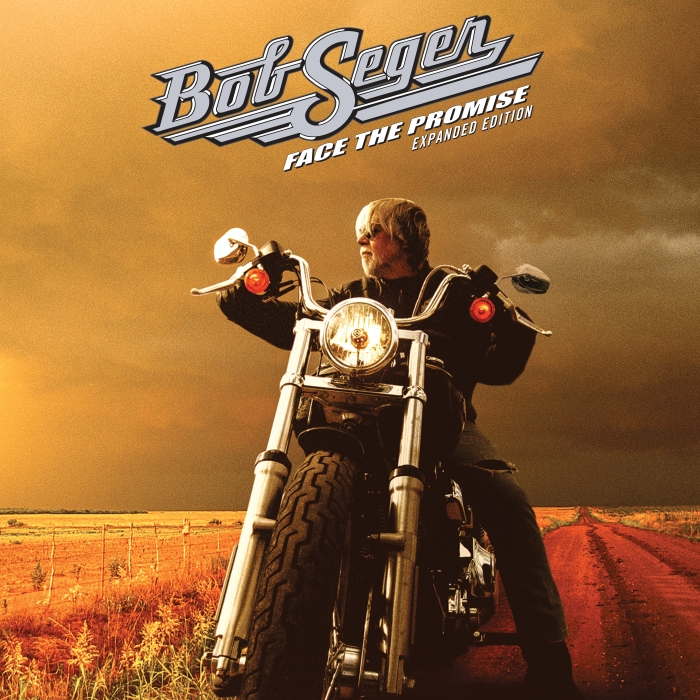
image courtesy of UMe
The record kicks off with crunchy guitar riffs, opening a classic Seger-styled rocker, “Wreck This Heart.” It’s an uptempo number, with a big in-your-face beat a la “Like a Rock” but with a faster tempo, cool background vocals punching up some key spots in the song – any Detroiter would appreciate that Motown backing vocals staple – and a very Seger-esque everyday working man’s viewpoint in the lyrics. At the time, this was Seger’s first release since the last Bob Seger & the Silver Bullet Band release more than a decade earlier, and this song, I’m sure, put a lot of his fans’ concerns to rest, acknowledging that this was still Seger doing exactly what we love about him, just with the little tweaks and musical growth that make new music worth hearing and, of course, that are the whole point of creating something new for the artist himself.
What about a Seger ballad? Well, that’s song two, “Wait For Me.” Talk about goosebump-inducing! Seger delivers that smooth voice and adds soaring guitar runs and well-placed harmony background vocals, as pianowork and guitar strumming form the song’s basis. Two songs in, and just whew! What a record! (I can’t believe I was totally out of the loop on new music in 2006 and missed this!) Of Face the Promise‘s singles, “Wait For Me” was the only one to chart, though not on the Billboard Hot 100. Rather, it reached number 17 on Billboard‘s Adult Contemporary chart.
The record doesn’t slow down for long. A funky blues bassline supports title track, “Face the Promise,” a concert-ready rocker that includes shout-outs to several states, regions, and cities. You just know one of those locations would be replaced in a live concert with someplace local – crowds love when artists do this, obviously. In any case, this is a third slightly different variation of Seger’s identifiable style in the first three songs, all absolutely top-shelf. As an aside, one of the cool things here for locals (I mean here in Massachusetts, where I live, not in Michigan where I grew up) will be the Massachusetts call-out, a mention of Framingham, pronounced correctly. Just something for my adopted home state’s locals to listen for. Regardless of whether or not you connect with one of the regional mentions, the hypnotic, sidewinding rhythm of “Face the Promise” is going to snag you and make this song a fast favorite.
photo by Cybelle Codish; photo courtesy of UMe
Next up, “No Matter Who You Are” kicks off with a familiar keyboard rhythm, at least similar to past Seger intros on his slower, heartfelt boomers. And the Motown-esque background vocals continue to add depth and flavor to this album, as well as an uplifting feeling underpinning even the most hardscrabble lyrics. But yeah, this is definitely one of those sway-along songs.
Grindy, thumping, deep bluesy-rocker “Are You” follows. Then funky-rockin’ “Simplicity” (you’ll dig the cool horn parts!), which reminds me a little – but not too much – of “Shakedown” from the Beverly Hills Cop soundtrack. And “No More,” a soaring number with a big, orchestral rocking sound, follows, with its big, expansive, wide-open sound.
“Real Mean Bottle” is a raucous, rollicking duet with Kid Rock, with Kid Rock’s thinner grizzled vox meshing exceptionally well with Seger’s richer, fuller delivery. It’s followed by a heavy, dirge-like, flowing ballad, “Won’t Stop.” Next up is “Between,” a rhythmic, slightly funky, drum- and bass-driven thumper about social isolation and disillusionment with a nod to the environmental crisis and the need for more societal cooperation.
“The Answer’s in the Question” is a country-tinged, flowing ballad, a duet with Patty Loveless that you’d think should have been a massive commercial hit, with a violin helping countrify Seger’s vocal parts, while Loveless, of course, contributes her own piercing, country vocal power. When singing together, the vocal combo is an exceptional blend of Seger’s gravel and Loveless’s purer delivery.
The final song of the original dozen are the soulfully crooned “The Long Goodbye.”
The “expanded edition” of the album concludes with those four additional tracks I mentioned. Four songs that are, except for those who had heard the iTunes-exclusive “Red Eye to Memphis,” are new to everyone. The first of this foursome, “Time,” is a blues-based rocker, with the rhythm section setting a heavy, thumping baseline upon which Seger’s vocal wails could sit, accompanied by some blistering, slightly distorted axework, including a long, dancing solo to conclude the song.
“Little Jane,” which dropped as a single on July 23 this year almost two months in advance of the Face the Promise (Expanded Edition) release, is absolutely single-worthy. (How was this a previously-unreleased track?! And what other unreleased gems are sitting in that vault?) Seger’s delivery on this number is matter-of-fact rather than booming, though he does ramp it up a little in a couple spots. But it’s the emotional quiver Seger can do so well that provides “Little Jane” with its subdued pizzazz. This is a song you could hear Seger singing perhaps alongside similarly-tempoed Springsteen or Mellencamp tunes. Would a songwriters’ circle of these three be too much to ask? Probably. But a selection of this song from Seger followed by similar tracks from the rest of that trio would be the beginning of a cool, laidback playlist.
“Red Eye to Memphis” is a gritty blues number – really, with a title like that? Who’d’ve guessed? Seriously, though, the beat just oozes cool, with Seger in top form at the blues end of his range, and some nifty guitar parts and harmony/backing vocals punching up a few vocal wails.
The extended collection closes with “Let Me Try.” A song about life’s difficulties, with a knowing empathy very few can pull off as well as Bob Seger. And just when you think the song has settled in, you get some big-time gospel background vocals lifting it up another notch for its final minute. A terrific way to end a great album.
Now, if you know this album already, I’m sure it’s a favorite, and I hope you’ve enjoyed my assessment of the original dozen songs and my take on the 4 new bonus tracks. And if you’re like me – life happens, sometimes you’re not discovering new music for a while, and you may have missed it – this album is an absolute treat for Bob Seger fans who are just discovering it. Join me; it’s so absolutely worth listening to… repeatedly!

